
Methods of examining the connected speech of older preschool children
Автор: Ли Анастасия Витальевна
Организация: NRU «BelSU»
Населенный пункт: Belgorod region, Belgorod
Annotation
The article examines modern methods for assessing coherent speech in older preschool children. It describes the theoretical foundations of coherent speech development, the characteristics of speech formation in children aged 5–7, and diagnostic approaches that help identify the level of monologic and dialogic speech development. The analysis includes methods such as retelling, storytelling based on picture sequences, single‑picture descriptions, cue‑word narratives, and continuation of a given beginning. The article also discusses the evaluation of grammar and vocabulary. The material is intended for speech therapists, preschool educators, and students of special education.
Key words: coherent speech, speech diagnostics, preschoolers, speech therapy, retelling, monologue speech, speech development.
Аннотация
В статье рассматриваются современные методики обследования связной речи детей старшего дошкольного возраста (5–7 лет). Представлены теоретические основы формирования связной речи, описаны диагностические подходы, критерии оценки, типичные трудности и особенности речевого развития. Особое внимание уделено анализу монологической и диалогической речи, пересказу, составлению рассказов по серии картинок и по опорным словам. Материал ориентирован на логопедов, педагогов дошкольного образования и студентов дефектологических направлений.
Ключевые слова: связная речь, диагностика речи, дошкольники, логопедия, пересказ, монологическая речь, речевое развитие.
Coherent speech is an extended, logically structured, and grammatically organized utterance aimed at conveying information to a listener. In older preschool age, children develop the prerequisites for academic learning, and the ability to express thoughts clearly and consistently becomes essential for successful school readiness [1]. Coherent speech includes logical sequence, semantic completeness, lexical accuracy, grammatical correctness, and the ability to consider the communicative situation. Speech therapists distinguish between dialogic and monologic speech. Dialogic speech is situational and relies on interaction with a partner, while monologic speech requires planning and independent construction of an utterance. By the age of seven, children are usually able to create short stories, use complex sentences, retell texts, and recognize narrative structure. However, many children still have trouble such as missing semantic links, limited vocabulary, grammatical errors, and disrupted logic.
The purpose of speech assessment is to determine the level of coherent speech development, identify difficulties, and define directions for corrective work. Diagnostics includes analyzing the structure of utterances, evaluating grammar, identifying vocabulary features, assessing coherence and logic, and examining communicative skills. One of the first stages is the analysis of dialogic speech, conducted in natural communication. The specialist engages the child in conversation about family, toys, or daily events [2]. The assessment focuses on the child’s ability to maintain dialogue, respond appropriately, initiate conversation, expand utterances, and ask questions.
Retelling is one of the most informative diagnostic methods. The specialist reads a short text, asks comprehension questions, and then the child retells the story. The evaluation includes completeness, sequence, accuracy, use of cohesive devices, and grammatical correctness. If necessary, a second retelling with visual support may be used. [4] This method reveals the child’s ability to understand text, retain information, and transform it into its own narrative [5].
Storytelling based on picture sequences assesses the child’s ability to construct a plot. The child must identify causal relationships, determine event order, and create a coherent story. The evaluation focuses on narrative logic, presence of beginning, climax, and ending, and correct use of verb tenses. Single‑picture storytelling assesses descriptive speech. The child describes objects, actions, and details, demonstrating vocabulary richness and ability to highlight essential features.
Cue‑word storytelling develops verbal‑logical thinking. The child must create a story using several given words, which reveals their ability to connect concepts and build a narrative. Similarly, continuation of a given beginning assesses the child’s ability to independently develop a storyline [6].
Grammar assessment is conducted alongside narrative analysis. The specialist evaluates agreement of words, use of complex sentences, lexical precision, and variety [7]. Cohesive devices such as conjunctions, pronouns, and temporal markers are important indicators of coherence. Speech tempo, intonation, and expressiveness are also considered [8].
Common difficulties among older preschoolers include missing semantic links, disrupted sequence, limited vocabulary, repetitive structures, grammatical errors, difficulty forming complex sentences, and low motivation for verbal expression [9]. These factors must be considered during assessment and intervention planning.
Speech assessment should be conducted in a supportive environment. Familiar topics and visual aids help the child feel comfortable. Diagnostics may be carried out in several stages to obtain an objective picture of the child’s abilities. The results form the basis for individualized corrective programs aimed at developing coherent speech and preparing the child for school [10].
References.
- Butenko A.V. Metaphorical associative maps in the context of psychological and pedagogical support for the implementation of the GEF OO in the practice of an educational institution. / Proceedings of the VIII All-Russian scientific and practical conference dedicated to the memory of Professor Alexander Georgievich Kritsky. 2019 – 44–48 p
- Efimenkova L.N. Methods for studying monologic speech in children aged 5–7. / Collection of scientific papers of the Institute of Correctional Pedagogy. 2019 – 74–81 p.
- Filicheva T.B., Chirkina G.V. Diagnostic approaches to assessing speech development in older preschoolers. / Materials of the International Forum on Preschool Education. 2018 – 56–62 p.
- Kornev A.N. Features of coherent speech formation in children with speech underdevelopment. / Materials of the scientific-practical conference on speech disorders. 2018 – 41–47 p.
- Lalaeva R.I. Development of coherent speech in preschool children in the context of modern educational standards. / Proceedings of the All-Russian scientific and practical conference on speech therapy and special pedagogy. 2020 – 112–118 p.
- Novikova E.A. Narrative skills in preschool children: diagnostic criteria and methods. / Proceedings of the IV All-Russian conference on preschool pedagogy. 2022 – 128–134 p.
- Sobotovich E.F. The role of vocabulary in the development of coherent speech in preschool age. / Proceedings of the International Congress on Child Development. 2019 – 203–209 p.
- Ushakova O.S. Modern technologies for diagnosing coherent speech in preschoolers. / Collection of methodological developments for speech therapists. 2021 – 58–64 p.
- Vygotsky L.S. Psychological foundations of the development of children’s speech activity. / Collected works of the International Conference on Developmental Psychology. 2017 – 9–15 p.
- Zhukova N.S. Assessment of grammatical structure in the speech of preschool children. / Proceedings of the scientific and methodological seminar on speech therapy diagnostics. 2021 – 33–39 p.
Опубликовано: 24.03.2026
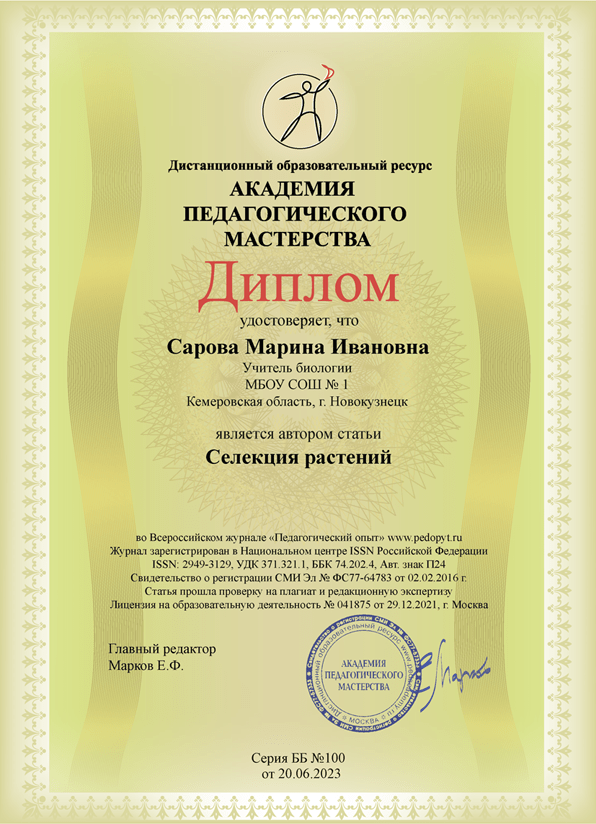
Пример сертификата за публикацию статьи


Пример диплома за конкурс


Пример бумажного диплома

Регистрация в Федеральной службе по надзору в сфере связи, информационных технологий и массовых коммуникаций (Роскомнадзор)

Регистрация в Национальном центре ISSN Российской Федерации: 2949-3129