Game space markers as an element of a developmental environment
Автор: Сорокина Кристина Андреевна
Организация: НИУ БелГУ
Населенный пункт: Белгородская область, г. Белгород
Abstract. This article examines the consistent use of markers applied in any type of activity (cognitive-research, play, communicative, creative, physical, etc.), which allows for the effective implementation of new modern approaches to organizing the educational process in Preschool Educational Institutions. It shows the advantages of game space markers and what materials can be used for making them. The article discusses the simultaneous use of various types of markers: floor-based, tabletop, role markers, ambiguous, and multifunctional ones.
Keywords: marker, polyfunctionality, transformability, variability.
The Federal Law «On Education in the Russian Federation» dated September 1, 2013, defined a new status for preschool education, establishing it as a level of general education. The Federal State Educational Standard for Preschool Education was developed, representing a set of mandatory requirements for preschool education and program implementation. The leading activity in preschool age is play, therefore it is in play that a child displays their best qualities, learns about the world, and prepares for life in the adult world. Through playing, a child develops, is brought up, and learns. Children with rich play experience demonstrate creativity more actively than those who lack play practice. The nature of a preschooler's play, their actions, experiences, and feelings depend on the developmental environment surrounding them. For the environment to be developmental, rather than filled according to the principle of «the more toys, the better», it is necessary to follow the requirements of the Federal State Educational Standard for Preschool Education.
Adhering to the requirements of the Federal State Educational Standard to develop curiosity, independence, ingenuity, memory, and imagination in preschoolers, Candidates of Psychological Sciences I.L. Kirilov and N.A. Korotkova recommend using game space markers as an element of a developmental environment. Thanks to markers, children gain an additional opportunity to create and fantasize at a level accessible to preschoolers, which is the key to success.
The technology of using game space markers, authored by Candidate of Psychological Sciences Nadezhda Aleksandrovna Korotkova, who conducted research in the field of children's play, also confirms their advantages. Let's look at what markers are. Game space markers are simple samples of reduced-sized objects, didactic play material of simple construction, and suitable models of objects from an imaginary world. This is simple, handmade play equipment with universal, interchangeable application in play activities. Markers can be practically anything and designate the play space as the playing children wish – this is their main advantage.
Game space markers have the following advantages and meet modern Federal State Educational Standard requirements: they are assembled from inexpensive, readily available materials; they are easy to use, lightweight, easily foldable and portable, and take up little storage space; they are safe, can be cleaned with a soapy water solution, and meet hygienic requirements; they have an attractive, aesthetic appearance; they are easily transformable into various play objects; they are universal and multifunctional; they are varied and multifunctional; they are capable of developing children's imagination and fantasy; they correspond to the age categories of children from 3 to 7 years old; they can be used both indoors and outdoors.
By applying game space markers in our preschool settings, we solve many educational and developmental tasks: enriching the content of preschoolers' story-based games based on obtaining information about phenomena of social reality; enriching preschoolers' sensory experience, improving and using analytical perception; developing preschoolers' cognitive activity, the ability to independently organize games and play exercises; promoting the development of a child's motor activity; fostering goodwill, friendliness, and caring towards peers in the process of joint activities; the use of markers allows preschoolers to independently organize and transform the play space, creating a comfortable atmosphere.
The practical application of universal game space markers delimits the play space and does not hinder story-based play due to their transformability, mobility, and changeability. They can also be included in a new play activity, as they do not carry any inherent semantic load or emotional coloring.
Game space markers come in the following types: floor-based, tabletop, "Book" marker, role markers, ambiguous, and multifunctional.
Floor-based markers – the possibilities for their use are multifaceted, as they utilize lightweight screens consisting of frames covered with fabric and having a different number of sections: from one to four. The main requirement for a screen is safety, non-toxicity, lightness, and hygiene. Markers of designation and selection, applications and attributes that reveal a mystery or depict scenes (a hut, a train station, a clearing, a hospital) are attached to the screen using clothespins, ties, or Velcro. Such screens are convenient to use as privacy corners, taking into account gender and socio-cultural characteristics, as well as as part of the decorations. Covers for children's chairs can also serve as an effective means for designating space – such a marker is convenient in the activities of both the child and the teacher.
Tabletop markers – the possibilities for their use are also multifaceted: they are used when playing at a table with small toys, construction sets, small animal figures, and cars. They are used for play by both a single child and a small group of children. These markers are not attached to models but are kept in a play box; children can freely move them across the entire surface of the play field. Preschoolers themselves choose the necessary elements in accordance with the play idea and changes in the plot. The use of tabletop markers contributes to the development and education of preschoolers; they are colorful and engaging, therefore interesting to children.
The «Book» marker has four spreads and eight sides. It can be used for play by two people or by a group of children. The possibility of using this marker allows preschoolers to build their own plot or combine plots into one common one, and to change the plot according to the situation.
Role markers – the possibility of their use helps children transform themselves, take on a new position, feel like a different character, and maintain that feeling throughout the game. For preschoolers, role markers are very attractive: they are understandable and allow them to be exactly what they need to be in the game. This marker reminds the child who they are, not only to themselves but also to the children playing nearby, who see their image, actions, and transformation, and engage in the dialogue of the game.
Multi-valued markers are folding markers. They are easily transformed into attributes for story-based games, for example, a swimming pool, a sandbox, a river, a road, a fence. For instance, a ship that can turn into a plane or a car by simply changing its structure, for example, by replacing its parts with car wheels.
Folding markers are made from plastic panels cut into equal-length parts. All parts are connected using colored tape or self-adhesive film into one long sheet with gaps of 2-3 cm between the parts, so that the strip can be folded in any way convenient for the children playing.
In conclusion, it can be said that game space markers, as one of the components of a developmental subject-spatial environment, contribute to the development of children. The use of markers makes it possible to influence the development of a child's emotional sphere, activate independent cognitive activity of preschoolers, increase the level of communication skills, enhance self-esteem, and create conditions for learning in various types of preschooler activities.
References.
- Federal Law (2012), «On Education in the Russian Federation», from 29.12.2012
- Savitskaya, N. M., Safonova, L. O., & Lavrentieva, O. I. (2016). Markery igrovogo prostranstva [Game space markers]. Voprosy doshkol'noy pedagogiki [Issues of Preschool Pedagogy], (1), 118-127.
- Federal State Educational Standard for Preschool Education. (2013, October 17).
Опубликовано: 20.03.2026
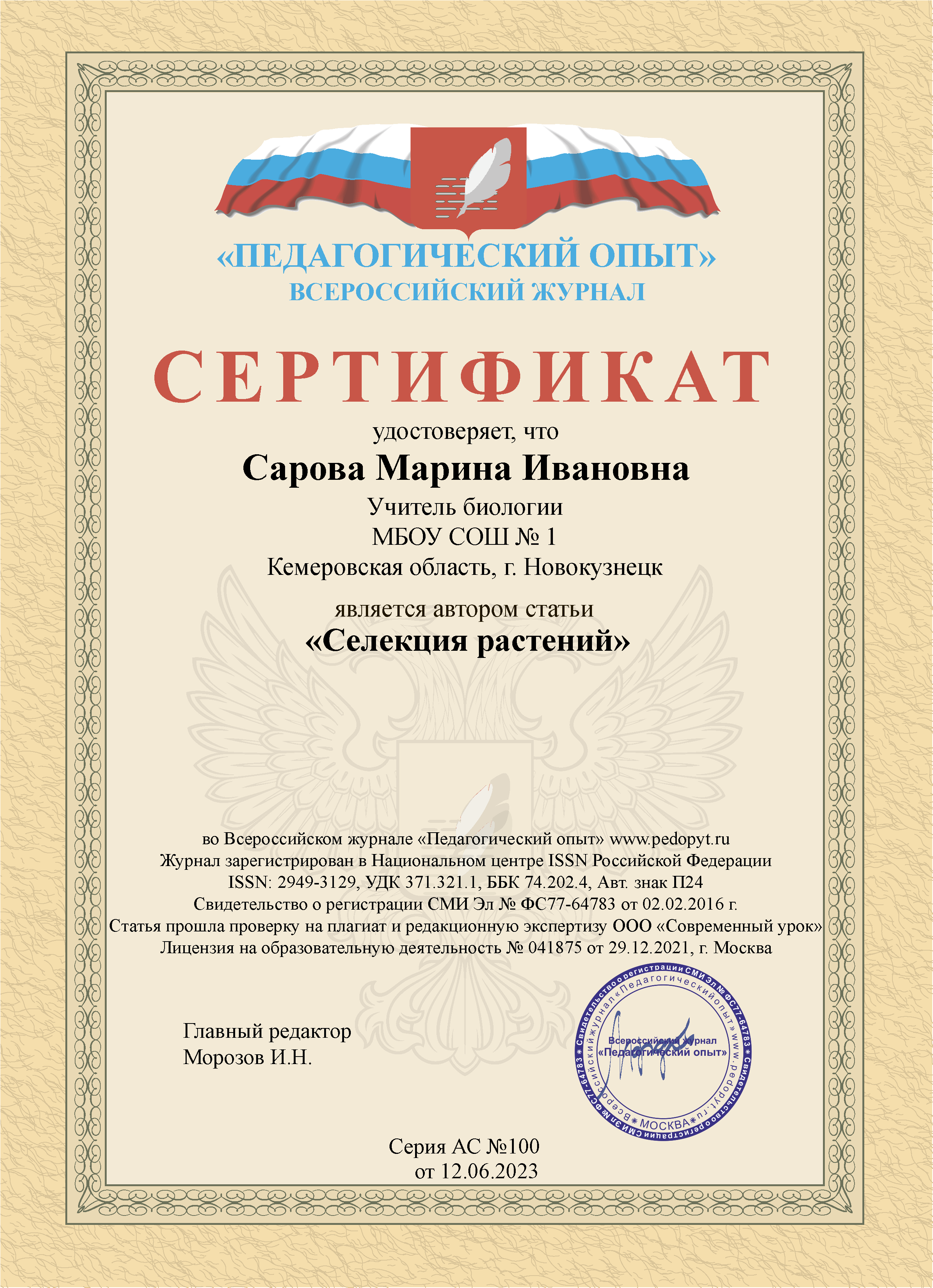
Пример сертификата за публикацию статьи
Пример диплома за конкурс
Пример бумажного диплома
Регистрация в Федеральной службе по надзору в сфере связи, информационных технологий и массовых коммуникаций (Роскомнадзор)

Регистрация в Национальном центре ISSN Российской Федерации: 2949-3129