Game Technologies in Primary Education
Автор: Швец Татьяна Евгеньевна
Организация: ГБОУ СОШ № 478
Населенный пункт: г. Санкт-Петербург
Game Technologies in Primary Education
Tatyana Shvets
One of the main tasks of an elementary school teacher is to develop children’s ability to apply acquired knowledge in practice, as well as adapt to the modern world and be able to realize themselves in the future. One of the ways to solve these issues is the use of modern pedagogical technologies in the educational process, which allow diversifying forms and means of teaching, increasing students’ creative activity, and developing cognitive abilities.
Any technology has tools that activate students’ activities, while in some technologies these tools constitute the main idea and basis for the effectiveness of results. These include game technologies. In various educational systems, a special place is given to the game, and this is determined by the fact that the game is in tune with the nature of the child. A child, from birth until maturity, pays great attention to various games. As V.A. Sukhomlinsky once said: «Without play, there can be no full mental development. Play is the spark that ignites the flame of inquisitiveness and curiosity».
Classification of Games
Modern pedagogical literature presents a wide range of approaches to classifying games. Let’s focus on some of them:
- Creative games and their variations: dramatization games, construction games, role-playing, director’s games
- Active games
- Didactic games
- Natural and artificial games, etc.
G.K. Selevko classifies pedagogical games according to the following parameters of game technologies:
- By area of activity: physical, intellectual, labor, social, psychological
- By nature of the pedagogical process: educational, training, controlling, summarizing, cognitive, developmental, reproductive, productive, creative, communicative, diagnostic, career guidance, psychotechnical
- By game methodology: subject-plot, role-playing, business, simulation, dramatization
- By subject area: mathematical, musical, theatrical, labor, technical, folk, managerial, commercial, etc.
- By game environment: without objects, with objects, tabletop, room, street, television, computer, etc.
Thus, considering different approaches to classifying games, it is necessary to understand that play is not only children’s activity or business games. It has a return-permanent nature and is clearly expressed in the behavior of most adults.
Key Principles of Game Technologies
- Natural and cultural conformity
- Ability to model and dramatize
- Freedom of activity
- Emotional elevation
- Equality
Types of Educational Games
Didactic games help reveal content in an accessible and engaging form, form mental actions, and help children better understand themselves and the surrounding world.
Physical development through games occurs as children perform various movements, develop muscles, and release excess energy.
Psychological development is facilitated by games that promote voluntary behavior and mental growth.
Moral education takes place as games serve as a school of morality and a transition to a new developmental stage.
Practical Implementation
Game technology is applied by educators working with students of various ages, from the youngest to high school students, and is used in organizing classes across all activity areas. This helps children experience real situations and prepare for decision-making in life.
Modern technologies in educational institutions combine valuable elements from domestic and foreign experience, family and folk pedagogy. They allow selecting the most effective methods and techniques for organizing children’s activities and creating optimal conditions for their communication, activity, and self-development.
The modern organization of the educational and воспитательный process has a personality-oriented focus, contributing to the full development of abilities needed by both the individual and society. It involves the personality in socially valuable activity, promotes self-determination, and provides opportunities for effective self-education throughout subsequent life.
Опубликовано: 20.01.2026
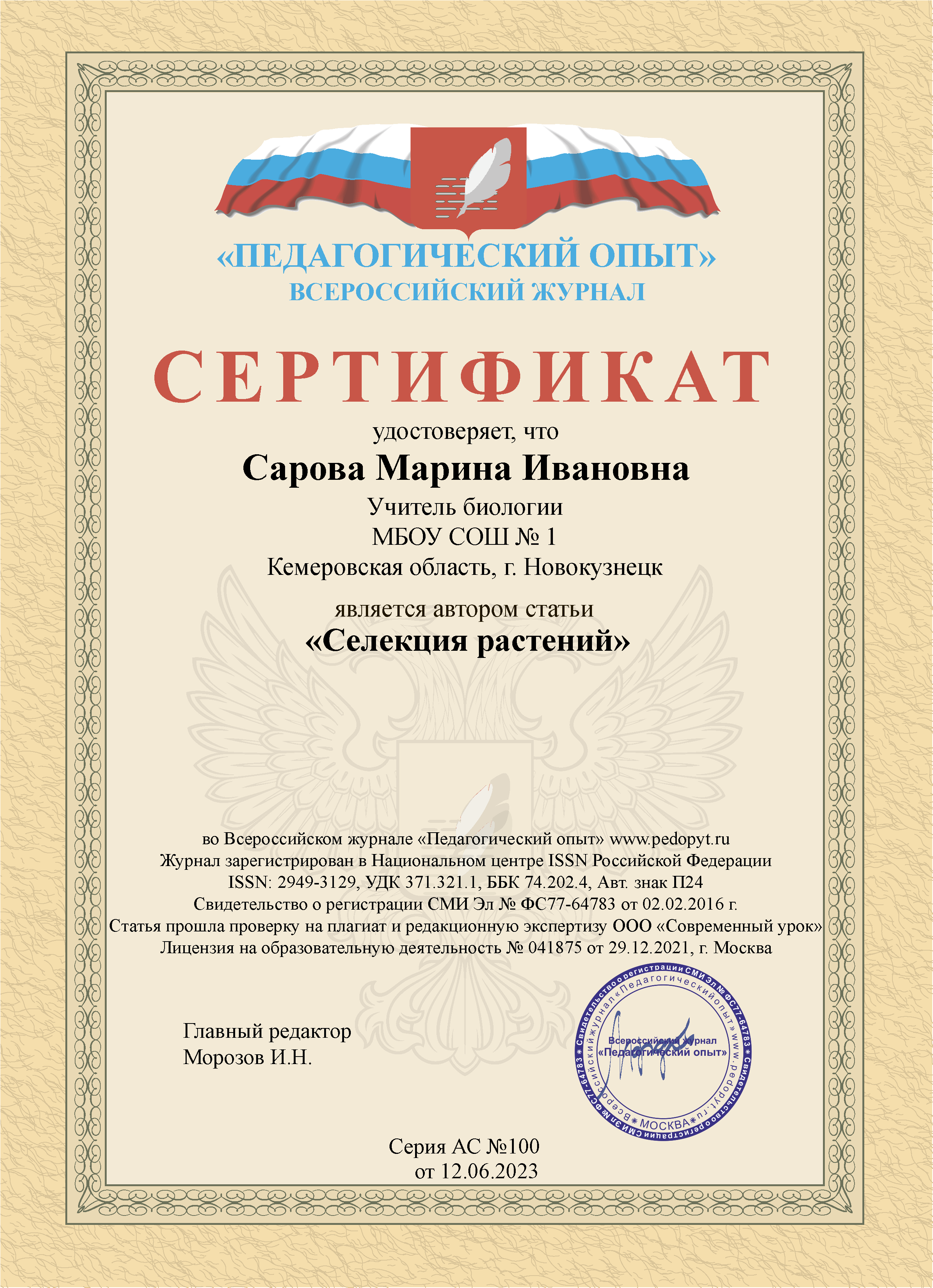
Пример сертификата за публикацию статьи
Пример диплома за конкурс
Пример бумажного диплома
Регистрация в Федеральной службе по надзору в сфере связи, информационных технологий и массовых коммуникаций (Роскомнадзор)

Регистрация в Национальном центре ISSN Российской Федерации: 2949-3129